
OpenClaw vs Hermes Agent: Which AI Agent Framework Should You Choose in 2025?
OpenClaw and Hermes Agent are the two most-watched open-source autonomous AI agent frameworks of 2026 — but they were built on fundamentally different philosophies. This deep-dive compares their architecture, memory systems, security track records, and self-improvement capabilities so engineers can make an informed decision before committing to a stack.
OpenClaw vs Hermes Agent: Which AI Agent Framework Should You Choose in 2025?
Summary: OpenClaw and Hermes Agent are the two most-watched open-source autonomous AI agent frameworks of 2026 — but they were built on fundamentally different philosophies. This deep-dive compares their architecture, memory systems, security track records, and self-improvement capabilities so engineers can make an informed decision before committing to a stack.
April 14, 2026
Two Frameworks, Two Philosophies
The autonomous agent space moved faster in late 2025 than anyone predicted. OpenClaw, originally published in November 2025 by Austrian developer Peter Steinberger under the name Clawdbot, exploded to 247,000+ GitHub stars and 47,700 forks within 60 days — a pace that outran React's first decade. Hermes Agent, built by Nous Research, took a quieter path: a self-improving agent designed to grow more capable the longer it runs, with a layered memory architecture and zero reported CVEs as of April 2026.
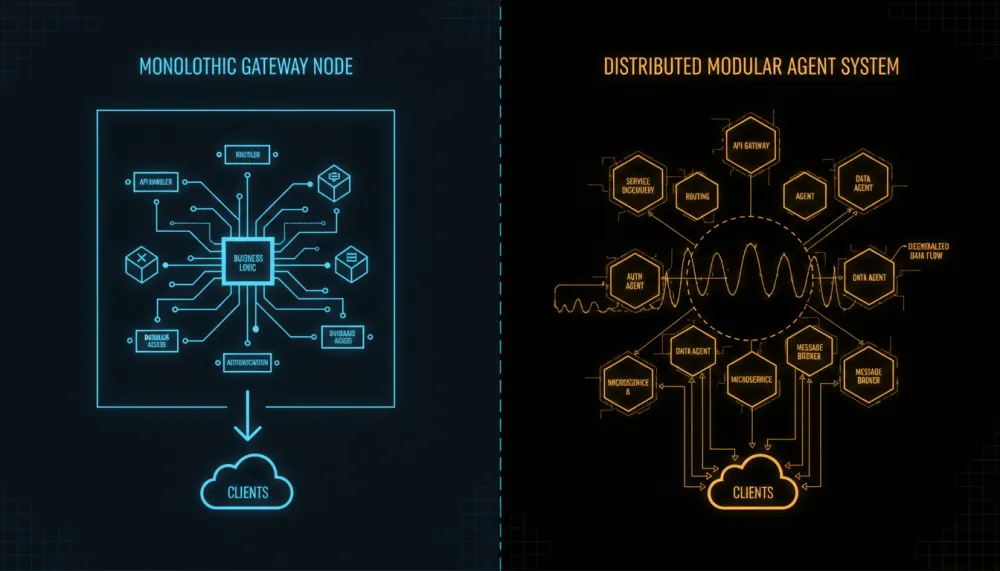
The core philosophical split is this: OpenClaw routes everything through a central gateway — one Node.js process, one session manager, one place where all channels land. Hermes grows outward from a single agent, building its own skills and memory autonomously across sessions. Choosing between them is not a matter of which is "better." It's a matter of which model of intelligence fits the problem you're solving.
Architecture Under the Hood
OpenClaw runs as a monolithic Node.js process. The LLM interaction engine, skill-loading system, WebSocket gateway, memory subsystem, and CLI all share the same event loop and memory space. This makes it fast to deploy and trivial to configure — you drop a SOUL.md file, wire up your messaging channels, and the agent is live. The tradeoff is coupling: everything is co-located, which simplifies operations but concentrates risk.
Hermes Agent is a Python system with six execution backends: local, Docker, SSH, Daytona, Singularity, and Modal. Each backend isolates execution with container hardening and namespace isolation. This architecture is more operationally complex, but it gives you significantly more control over the blast radius of any single failure. OpenClaw is designed for accessibility; Hermes is designed for durability.
Channel Coverage
OpenClaw connects to WhatsApp, Telegram, Discord, iMessage, Slack, and a built-in browser chat through its unified Gateway. Hermes covers Telegram, Discord, Slack, WhatsApp, Signal, and CLI. If iMessage support is a hard requirement — common in consumer-facing products — OpenClaw wins that specific point. For developer and enterprise workflows, the channel sets are effectively equivalent.
Memory, Skills, and Self-Improvement
This is where the two frameworks diverge most sharply. OpenClaw skills are static files. You write them, you maintain them, and they do what you programmed them to do — no more. The ecosystem of over 100 preconfigured AgentSkills and 162 community-contributed templates on GitHub is genuinely useful, but the agent itself contributes nothing to that library over time.
Hermes operates on a fundamentally different model. Its built-in learning loop creates procedural skills from experience, refines them during use, and reuses them across sessions. The memory system is layered: session memory, persistent cross-session memory backed by FTS5 full-text search, LLM-powered summarization for long-horizon recall, and Honcho user modeling. In one documented benchmark, Hermes completed a research task 40% faster on its second run than its first.
For teams that run the same classes of tasks repeatedly — research pipelines, code review workflows, data extraction jobs — Hermes's compounding skill library is a structural advantage. For teams that want predictable, human-authored agent behavior with a large community of pre-built templates, OpenClaw is the more controlled choice.
Security: A Critical Differentiator
OpenClaw disclosed 9 CVEs over four days in March 2026. The most serious, CVE-2026-25253 (CVSS 8.8), allowed any host on the same network to extract stored API tokens. Security researchers found 135,000+ exposed instances across 82 countries. The monolithic architecture that makes OpenClaw easy to deploy is the same architecture that made this vulnerability widespread.
Hermes Agent has zero reported agent-specific CVEs as of April 2026. The isolated execution backends mean that even if one component is compromised, the credential surface is contained. For any production deployment handling sensitive data, this difference is not academic. It is a risk management decision that should factor into your framework evaluation before a single line of agent code is written.
The Verdict: Which Framework for Which Team
OpenClaw wins on rapid deployment, consumer channel breadth, managed hosting options, and an exceptionally large community ecosystem. If you need an agent running in days rather than weeks and your threat model is low, OpenClaw gets you there fastest.
Hermes Agent wins on self-improvement, memory depth, security posture, and deployment flexibility. If you are building something that needs to get smarter over time, handle sensitive infrastructure, or run reliably in production for months, Hermes's architecture earns its additional setup cost.
Conclusion
The right framework is the one that matches your production reality, not your prototype ambitions. OpenClaw is the faster path to something working; Hermes is the more defensible path to something that keeps working — and keeps improving. Evaluate both against your security requirements and your task repetition patterns before you commit. The agent you choose today will shape your infrastructure for years.